
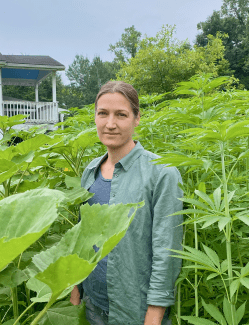
On her regenerative hemp farm, Small/Beginning Farmer of the Year Awardee Robbin Pott is bringing back an industry nearly lost to American agriculture and providing young adults with meaningful opportunities in the process. As one of only two farms in Michigan to achieve Regenerative Organic Certification, Pott cultivates hemp with practices that prioritize soil health, biodiversity, and the well-being of those who work the land. Hemp, banned for more than 80 years and stripped of its genetics, machinery, and institutional knowledge, represents a new frontier in the state. With no large-scale growers or hemp mills in Michigan, Pott is determined to keep the industry alive by experimenting with both flower and fiber varieties, diversifying into other crops to manage risk, and advocating for policies that reduce barriers and costs for small farmers.
Much of Pott’s innovation centers on fiber hemp, a crop with growing potential for sustainable building materials and animal bedding. The plants are seeded in early May, harvested in August, and processed into two components: long, incredibly strong fiber and a woody inner core called hurd. Separating the two is notoriously difficult, but Pott has been demonstrating a small-scale decorticator, a machine that does just that, at educational events across the state. She has hosted field days and hands-on workshops where visitors learn to grow hemp, process stalks, and even make hempcrete blocks. Interest has come from people of all ages and backgrounds, along with researchers from institutions including the University of Michigan and Western Michigan University who are studying hemp’s structural potential and market possibilities. Pott hopes that shared equipment and local processing infrastructure will eventually help small farmers participate in emerging hemp markets.
Her commitment to regenerative farming runs even deeper beneath the soil. Working with her own compost, cover crops like winter rye and clover, and minimal tillage, Pott builds soil biology that can sustain itself year after year. As a certified Soil Food Web Consultant trained under Dr. Elaine Ingham, she regularly uses microscopes to monitor microbial life and tailors her practices to support a thriving soil ecosystem. The farm, once an uncultivated grassland, is now a living demonstration site where hemp, annual flowers, rotating chickens, and managed woodlands work together to strengthen both ecological resilience and long-term land stewardship. She is exploring conservation planning and future agro-tourism opportunities to help others learn from the landscape she is restoring.
At the heart of Pott’s work is her dedication to young adults. Before farming, she served as a children’s advocate and program developer at the University of Michigan Law School. She says the farm was created to support young people facing instability, offering practical work and guidance from caring adults. Her internships remain the driving purpose of the operation. Consulting work and hemp sales help fund these opportunities, creating a circular system where the farm, the plants, and the young people all support one another. For many interns, the farm becomes a refuge, a place to be in nature, learn practical skills, build confidence, and imagine future possibilities. That impact, more than anything, is what keeps Robbin Pott committed to pioneering a sustainable and socially rooted future for hemp farming in Michigan.