
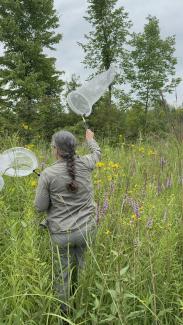
Shawn Severance, Naturalist with Washtenaw County Parks and Recreation Commission, at Independence Lake Prairie scouting (and finding!) rare bees. Photo credit: Terzah Hill, WCCD Staff
Did you know Michigan has over 460 species of native wild bees? They are excellent pollinators for farms, gardens, and orchards. These native bees evolved alongside the crops domesticated by Native Americans like tomatoes, blueberries, and squash. As most wild bees overwinter in plant stems or in the soil, fall garden care can either eliminate them or encourage their abundance. With a few small changes, you can invite these gentle guests to visit and stay awhile.
MASON BEES IN THE SPRING ORCHARD
In the fruit orchard, a single Mason bee can accomplish the pollination work of roughly 60 to 100 honeybees. They fly through cold and rain, and unlike honeybees that pack pollen into a pellet, they belly drag through the flowers, shed loosely held pollen onto the next flower, and voila: plums, apples, peaches, apricots and cherries! The adult bees only fly 4-6 weeks in the spring. For the other 11 months of the year Mason bee offspring are alive and well inside of hollow plant stems. During summer, they develop from egg to winged adult by eating the pollen stored by the mother bee. They then ride out the winter's cold with nothing but an Echinacea stem for a blanket. If you prune at the wrong time, you could send them to the compost heap.
Tip #1: Prune perennial stems in their first winter.
September-December: Leave dried seedheads in place to feed overwintering birds like Chickadees. If there are still seeds by December, make seed head bouquets and tie them to a fence post.
December-March:Trim twigs and stems back to leave a stubble 12 to 24 inches tall. This precise trimming helps maintain a tidy, uniform look for the winter garden and creates maximum habitat for stem-nesting bees. Later, this stubble will be ready and waiting as soon as early spring bees begin to search for nest locations. Only trim stems that just finished growing the previous summer. Stems from previous years may contain bees.
April-May: A fresh generation of Mason bees will emerge when temperatures rise above 55 degrees for a few days in a row. Watch the cut stems, and you can see the mother bee going in and out. We have dozens of Mason bee species in Michigan - one of the most common is the Blue Orchard Bee, a small bee with a dark metallic blue-black body. When the stem is full, she will cap the end with mud. Hollow stems might also host gentle, solitary wasps. If you see little pieces of grass poking out of the end, that is the hallmark of a grass-carrying wasp.
Tip #2 Prune once, and let nature do the rest.
Over time, cut stems will decompose on their own. At a certain point of crumble, the bees will no longer use them. Let this timeline be a dialogue between the plant, the bees, and the soil decomposers. Only prune once. Let nature do the rest. The bees will decide when the stem is no longer useful as the soil reclaims the plant. (Perennial pruning video)
Tip #3: Cultivate perennials and shrubs with sturdy, thick stems.
Cavity nesting bees like Mason bees prefer a 5/16"-3/8"diameter stem. Shrubs like Elderberries, Roses, Raspberries, and Wild Currant are very useful as well as flowering perennials like Bee Balm, Blazing Star, Purple Coneflower, Sunflower, and Thistle. (Full list) Forgo native bee houses which can become death traps, accumulating pests and parasites over the years. Remember, wild bees are used to being widely dispersed in the landscape. Bee houses create an unnatural concentration that makes them easy targets for predators, from skunks to parasitic wasps.
BUMBLEBEES IN THE SUMMER GARDEN
When ripe tomatoes hang heavy on the vine, the importance of bumblebees is clear. Every garden tomato owes its existence to a native bee. The Aztec were the first to domesticate this summer staple - tomatl in the classical Nahuatl language - and native bees know just how to work this familiar flower. Tomatoes require buzz-pollination to shake the pollen out. Bumblebees and other native bees grab the flower with their mandibles and vibrate with a pitch of C sharp. A tuning fork can also pollinate a tomato, but a honeybee cannot. Honeybees were imported from Europe in the 1600s.
Tip #4 Leave Undisturbed areas for Nesting and Overwintering.
Bumblebees are North America‘s only native social bee. Like honeybees, they form a colony with workers, males and a queen and they store nectar in honeypots. We have about 10 bumblebee species in Southeast Michigan. The queens only live a year, if they are lucky. They emerge in spring and build a nest and a growing brood of workers. By late summer, when the colony is at its maximum size, new young queens and males emerge. When fall comes, the foundress queen, males, and workers all die. The future of the bumblebee species rests with these newly mated queens, who burrow into the soil to overwinter like tiny bears.
Designate a messy zone where the tall grasses and leaves are undisturbed, just as nature would do. This provides insulation and safety for overwintering queens. About 70% of our native wild bees nest in the soil, so your wild garden corner will also support many solitary bees. It is a great joy to allow nature to go where she wants in the place that we share. The only maintenance needed is the comfortable placement of a lawn chair. Marvelous guests will grace you with their presence, but to see them you have to be still.
Tip #5 Set a Table for the Queen.
Fall is an excellent time to plant shrubs and perennials for spring bloom. Your fall planting can set the table for a new spring queen. She is now the foundress queen, and she has many jobs to do. Spring can be a time of scarcity, and she works alone. To raise her first generation of workers, she must to provision her nest with pollen, mature her ovaries, and lay eggs. For herself, she builds little honeycup. In inclement weather, she drinks from her honeycup and incubates her eggs. Providing rich sources of high-protein pollen supports rapid and robust larval growth for her first generation of workers. Bumblebee garden favorites include Virginia bluebells, Borage, Comfrey, Blue Sage, Red Clover, Hairy Vetch, and Lacy Phaceila. For native plant gardeners, Wild American Plum, Wild Lupine, Waterleaf, Penstemon, and Baptisia are excellent high-protein pollen plants for a queen bumblebee.
GARDENS MATTER!
Bees forage close to home. Although a Bumblebee can fly for a few miles, their foraging range is more often in the immediate neighborhood. Mason bees and other solitary species may only fly a few hundred feet from their nest. When many gardens, orchards, and farms provide food and shelter for these wild gentle creatures it adds up! As Van Gogh said, “Great things are done by a series of small things brought together.”
Note: If you can't plant, document! Many of our bumblebee species are in decline - map their presence by photographing them on flowers and uploading your pictures to iNaturalist or Bee Machine, Bumblebee Atlas, or another Community Science Project. (see iNaturalist observations of Bombus in SE Michigan).
Article by Shawn Severance, Naturalist with Washtenaw County Parks and Recreation Commission, edited by entomologist David Cappaert.
Shawn is celebrating 20 years with Washtenaw County Parks and Recreation Commission-Read more about her in this Observer Article. Join her in celebrating this milestone by helping to remove invasive bittersweet on Saturday, October 31 from 2-4 p.m. at Parker Mill County Park.

Terzah Hill
they/them
Outreach Coordinator