2026 Conservation Needs Assessment Results
Every five years, the WCCD conducts a conservation needs assessment to identify natural resource/environmental concerns in Washtenaw County, how residents use WCCD, and how we can best assist residents.
Thank you to all of the residents that gave us your input, we are using your responses to prioritize our work planning and programming.
Overall results and Reports:
- 796 responses were submitted
- 3 (randomly selected) participants received $100 visa gift cards
- View the 2026 Conservation Needs Assessment Results
Below is an abbreviated summary of the results.
WCCD Program Engagement
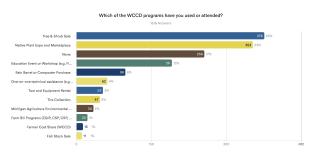
Most residents engage with our Tree & Shrub distributions and the Native Plant Expo & Marketplace. Most folks who replied "none" said they were not previously aware of our work, but might engage now.
Residents’ Natural Resource/Environmental Concerns
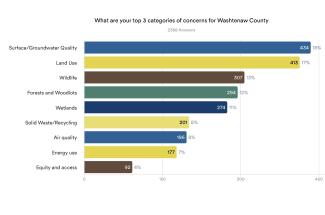
Specific Concerns for Top 3 Picks
Surface/Groundwater Quality
- Residents who selected this category are concerned about the groundwater (i.e. septic systems leaking, pollution, gravel mines) (34%) and surface water (i.e. algal blooms, runoff/non-point source pollution) (28%). Increased frequency of heavy precipitation, flooding events, and drought due to climate change (19%) was third.
Land Use
- Residents who selected this category are concerned about natural areas preservation (24%), data centers (23%), and development growth and zoning (e.g. suburban sprawl, urban heat islands) (22%).
Wildlife
- Residents who selected this category are concerned about the loss of habitat and connectivity (32%) and managing and restoring natural areas for wildlife (29%). Disease, pollution (including light), or invasive species impacts (19%) was third.
Residents’ Preferences for WCCD Program Categories
- Support partner organizations (e.g. local municipalities, non-profits, service providers) Partner to Protect Land, and Increase Community Resources are the top 3 concerns for Washtenaw County residents! See how the categories stacked up below.
Support Partner Organizations
- Residents who selected this category would like WCCD to increase technical assistance for municipalities (e.g. land preservation, habitat restoration, forestry), they'd like us to collaborate with municipalities on grant proposals and funding requests, and recommend policy and ordinance updates was third.
Partner to Protect Land
- Residents who selected this category would like WCCD to provide one-on-one technical assistance to help with land protection and conservation options (38%) a program to connect landowners with new farmers who want to buy land (32%), and more one-on-one technical assistance with conservation practices and cost-share programs (30%).
Increase Community Resources
- Residents who selected this category would like WCCD to offer additional resources (e.g. soil testing, cover crop seed, water testing) (24%) expand the tree/shrub and native plant distributions (e.g. increased frequency, plant selection, or capacity) (23%) and maintain an interactive database of conservation resources on the WCCD website (18%).
Demographics
A special thanks to respondents who elected to provide demographic information. We know these questions can be kind of uncomfortable and our intention is not to invade anyone’s privacy. By comparing your responses with County Federal Census data, it helps us evaluate whether we have done a reasonable job of capturing the unique perspectives of residents and identify trends with respect to age group, gender, and race/ethnicity. We are improving, but we still have a way to go to better capture the diversity in Washtenaw County and ensure all voices are heard.
- About half of respondents live in rural/farm (46%) settings, while the other half live in urban settings (city/village) (30%) or the suburbs (24%). Most respondents identified as homeowners/property owners (82%). The remainder are farmers (15%), rental residents (3.2%), or live with the property owner (0.2%).
- Respondents skewed older with 59% identifying as 55 or older. Although we are deeply grateful for the active participation and support of this segment of the population, we’d love to hear some younger voices too! Please help us spread the word about WCCD to younger generations by letting your kids, grandkids, and young neighbors know about our services.
-
City of Ann Arbor residents were the most vocal (29%), followed by Webster Township (8%) and the City of Chelsea (8%).
Any Washtenaw resident with an environmental/natural resource concern is welcome to call our office or email us and we’ll help or get you connected to someone who can!
Did your concern or program category not make the top 3?
Since we can’t do everything, our staff does have to prioritize, but rest assured that we heard you too and we’ll do our best to design programs and services that meet multiple needs and requests. Also, some respondents included specific information about issues they’re currently experiencing. We have a lot of comments to sift through, so please contact us if your request is an urgent one.
Volunteer!
You’ve given us a lot to think about, but while we mull over how to make your requests reality, let us know if you can help! Please sign up to learn about volunteer opportunities or donate to WCCD directly. Working towards an environmentally sustainable and equitable future is a collective effort and we’re thankful to be a part of this engaged and active community!