
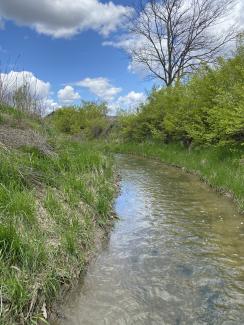
Little Sandy Creek is the southernmost sub-waterway in the Ottawa-Stony North watershed.
Sandwiched between the Huron River and River Raisin are a cluster of seven small drainages collectively known as the Ottawa-Stony North Watershed. Some of these creeks, such as Paint Creek and Sugar Creek, feed into larger ones as they move downstream, ultimately emptying into Lake Erie. Others, such as Sandy Creek and Mouillee Creek, outlet directly into Lake Erie. Unlike the Huron River or River Raisin though, the Ottawa-Stony North doesn’t have a watershed council to lead its stewardship activities. Until recently, there was no management plan to address its water quality.
In fact, one would have to go back over thirty years to see one of the last projects implemented within the watershed. The work done in Paint Creek was based on recommendations in a Watershed Management Plan, a document that guides local stakeholders and organizations in identifying and addressing water quality issues. These plans are often used to secure funding for the implementation of recommended best management practices.
Back in 1992, the goal of implementing the Paint Creek Watershed Project was to “maintain or improve the present water quality of Paint Creek.” The creek was designated as a “cold water stream” since it could support a trout population known as a cold-water fishery designated use. The project funded a detention basin just south of I-94 and west of Ford Lake to reduce flashiness, filter strips along farm fields to reduce nutrient runoff, and a Paint Creek Stewards Group to study stream characteristics. Speaking to local farmers today, many of those filter strips are still around, providing a buffer between agriculture and the winding creek. A lot can happen in over thirty years and right now Paint Creek is no longer designated as a “cold water stream.”
Changes to the landscape are nothing new. Glaciers formed the topography of our state, and over the years, people have changed what sits on it. Wetlands were tiled long ago. Farm fields have grown sub-divisions. Data centers and solar farms are the latest land altering issue facing the watersheds and communities all over the state. Change is inevitable, but it can be done wisely.
In 2024 the Washtenaw County Conservation District and its partners were able to develop a new Watershed Management Plan for the entire Ottawa-Stony North Watershed funded by the Michigan Department of Environment, Great Lakes and Energy’s (EGLE) Nonpoint Source program. This plan highlights current water quality concerns within the watershed and outlines priorities and strategies for addressing them. You can read the plan by visiting the following page on our website.
In early 2026, Washtenaw County Conservation District began work on its first implementation project based on recommendations in this recently approved Watershed Management Plan. Funded by a Nonpoint Source Implementation grant, we began the implementation of the Ottawa-Stony North Education and Demonstration project. With this funding, several projects will be going on within the watershed. This includes the installation of stormwater management practices at Calder Dairy and mailing information to residents about proper septic system maintenance and care. Finally, a series of rain garden workshops and tours will take place throughout the watershed.
While water quality can be impacted quite easily by a careless spill of a chemical or draining of a wetland, it takes more care and time to restore it. Stewardship is a constant, if not endless, process. Of course, this implementation project does not address every water quality issue in Ottawa-Stony North, but it is a return to action of stewardship that took place over thirty years ago. And with your involvement it will have staying power.
Whether you call Ottawa-Stony North home or not, seeing if your area has an approved watershed management plan is a great way to learn about conservation efforts in your backyard. Contact your watershed council or conservation district if you have questions about your watershed or want to support similar efforts in your area. Rivers and lakes need passionate people like you to do so.
Be on the lookout for more updates on the Ottawa-Stony North Education and Demonstration Project in your local media. If you have questions about the project, you can contact Nick Machinski at Nick@washtenawcd.org or Alex Caccari at Alex@washtenawcd.org.
Contact Us
Nicholas Machinski
he/him
Conservation Specialist
Alex Cacciari
she/her
Farmer Programs Specialist